
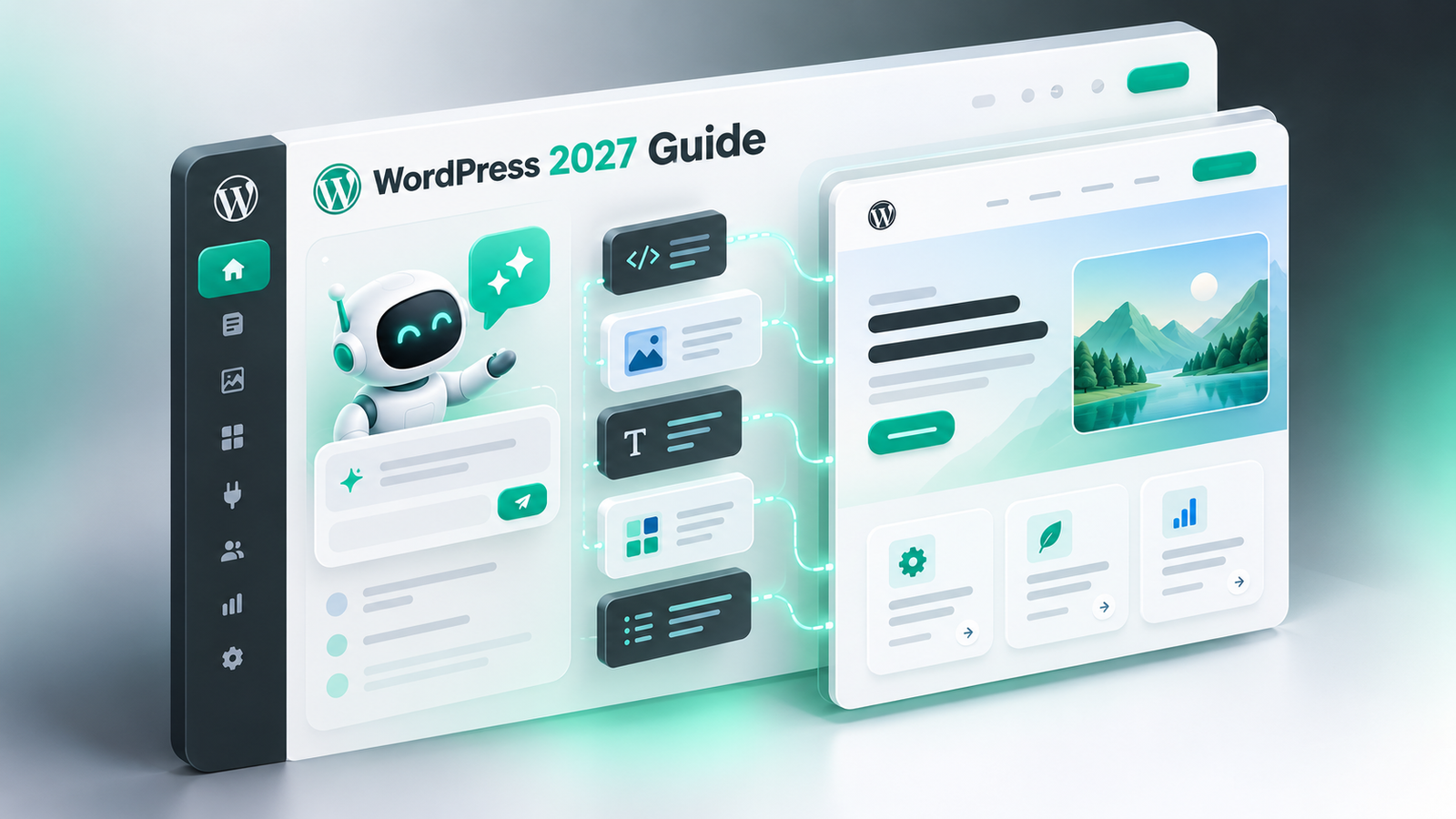

Starting a website can feel like trying to learn a new language overnight. But what if you had a platform that not only simplified the process but also used cutting-edge artificial intelligence to do the heavy lifting for you? Welcome to WordPress in 2027.
Whether you want to build a personal blog, an online portfolio, or a multi-million-dollar e-commerce store, this comprehensive WordPress guide will show you exactly why WordPress remains the world’s most dominant Content Management System (CMS) and how modern AI tools make it easier than ever for beginners to succeed.
At its core, WordPress is a CMS (Content Management System). A CMS is software that helps you create, manage, and modify content on a website without needing to write code from scratch.
Before systems like WordPress existed, building a website required writing complex HTML, CSS, and PHP code. Today, WordPress acts as a user-friendly operating system for your website, storing your text, images, and layout settings in a centralized database and presenting them beautifully to your visitors.
Before we dive deeper, it is crucial to understand the two versions of WordPress available:
For most beginners, we highly recommend WordPress.org because it unlocks the true power of custom plugins and the latest page builders.
In 2027, the traditional concept of a website builder has evolved dramatically. You no longer need to spend dozens of hours dragging and dropping elements manually or feeling stuck in rigid templates. Generative AI has been deeply integrated into the WordPress ecosystem, changing how we create and edit websites forever.
Elementor is one of the most popular page builder plugins in the WordPress ecosystem. With the integration of ai in elemntor (often searched as AI in Elementor), designing beautiful layouts is now as simple as talking to an assistant.
Using these built-in AI modules, beginners can:
It’s not just Elementor that has evolved. The widespread adoption of ai in apg ebuilders (the modern generation of AI page builders and block editors) has completely lowered the barrier to entry. AI-driven site builders like Divi AI, Spectra, and the default Gutenberg Block Editor now feature deep predictive designing.
These advanced tools analyze your industry niche and instantly suggest complete wireframes, optimize your loading speed, and even automatically apply accessible color contrasts to ensure your site is readable for everyone.
The days of struggling with custom CSS code to adjust a margins, padding, or colors are gone. When using ai to eidt wbeiste (using AI to edit website) structures, you can interact with your design through a natural language interface.
For example, you can select an entire page and type, “Make this section feel more playful and add a call-to-action button that matches my brand blue.” The AI immediately interprets your request, writes the necessary clean code in the background, and applies the changes live. This drastically reduces the learning curve for beginners, turning everyone into a competent designer.
How does WordPress compare to other platforms in 2027? Let’s take a look at this detailed comparison table:
| Feature/Metric | WordPress (Self-Hosted) | Wix / Squarespace | Shopify |
|---|---|---|---|
| Core Cost | Free (software), pay for hosting (~$4-$15/mo) | Subscription-based ($16-$50+/mo) | Subscription-based ($39-$399+/mo) |
| Customization Level | 100% Unlimited (Access to code & 60k+ plugins) | Limited to platform ecosystem | Highly optimized for retail, limited elsewhere |
| AI Capabilities | Deeply integrated (AI in Elementor, Gutenberg, etc.) | Proprietary AI templates | AI product descriptions & support |
| Ownership | You own your site and all data completely | Hosted on proprietary servers (cannot export site) | Hosted on proprietary servers |
| SEO Control | Excellent (Complete control over meta, schema, and speeds) | Good, but automated and less flexible | Good for e-commerce, limited for complex content |
Because of its highly flexible nature, you are never locked into one type of design. Here are some of the most common use cases:
Ready to get started? Follow these simple best practices to set up your website for long-term success:
Absolutely. Not only is it relevant, but it is also stronger than ever. Its open-source nature has allowed it to adapt to modern artificial intelligence technologies faster than proprietary platforms.
No coding skills are required. With block editors, drag-and-drop systems, and the ability to use AI to edit website features, you can build a stunning website using plain English.
While the WordPress software is free, you will need to pay for a domain name (approx. $10-$15/year) and web hosting (starting at $4-$10/month). As your site grows, you may choose to buy premium themes, plugins, or advanced AI features.
WordPress has transitioned from a simple blogging tool in the early 2000s into the ultimate AI-assisted digital creator platform in 2027. By understanding the core mechanics of this open-source CMS, utilizing cutting-edge tools like AI in Elementor, and keeping your site secure, you can bring any online vision to life. Start building today and shape your piece of the internet!


